Saturday, August 4

Giant Salvinia & Biological Control That Works

While I am usually never one to put my complete faith in using introduced insects to control invasive plant species, check out this article from the USDA about a weevil that feeds exclusively on the pesky giant salvinia, a free floating invasive fern from South America that is sometimes called the world's worst water weed.

Hopefully this will be a success story & when the weevils have completely eradicated the fern, they too will die off. After reading the article & thinking long & hard about my distrust in biological control, I guess if the introduced insect species is able to live in harmony with native species, even after the invasive weed is under control, it's not such a bad price to pay.

The Mile-A-Minute Vine

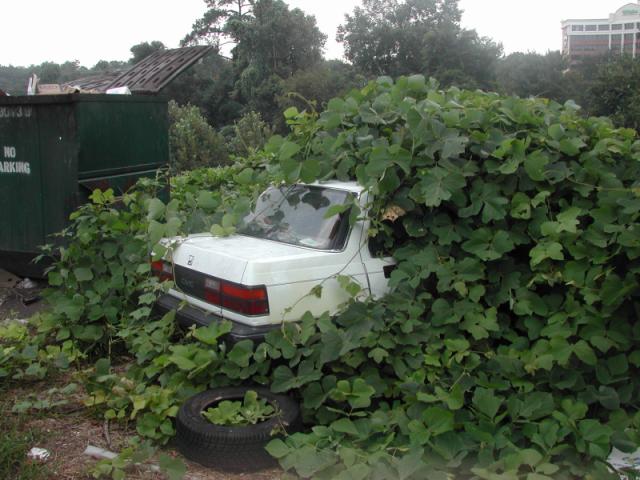
If you haven't already, please read this great poem about Kudzu by James Dickey. I have always been intrigued by this invasive plant, ever since my biology teacher in high school had us all believing that the sinewy green vines that grew throughout our Connecticut forests were kudzu. He later explained that what we have up north is actually bittersweet & that kudzu is a battle the south is facing. But still, every time I gaze upon the bushy mass of bittersweet growing over my fence, I can't help but think about kudzu.

I bet you didn't know that kudzu was non-native to the United States. Why would you? The sheer volume of it is staggering in the south. This fast growing plant can grow up to a foot a day in the summer months.

It's history in the US is quite interesting. Like many feral species, it was introduced to Philadelphia in 1876 when the Japanese government constructed a garden with native plants from their country to celebrate our centennial. People were so enraptured by the large leaves & sweet blooms that they started planting it in their own gardens & after it was discovered animals would use it as food & shelter, they actually began promoting the vine, marketing it at Floridian nurseries with signs reading: Kudzu Sold Here.

Soon kudzu was being promoted for erosion control & farmers were making good money for every acre they planted with kudzu. Today, more than a million acres of the south are dominated by this dastardly vine that chokes plants & blocks sunlight as it climbs trees, power poles, & anything else they contact.

Kudzu was officially declared a weed in 1972.

Solutions? Goats! In this article from The Christian Science Monitor, goats are being employed to chew until their heart is content on the kudzu, & they are able to clear out whole forests of the stuff.

Until cool weather presaged the fall livestock auctions last week, a herd of 20 goateed "girls" - including Nibbler, Suki, & Layla - chewed to their hearts' content through a forest of kudzu on the campus of North Carolina State University, pulling down the unruly Japanese vines & devouring leaves, stems, & roots as though they were a Thursday night special at the local diner.

Hopefully, this solution will not only help rid the goats of their bad reputation, especially at North Carolina State University, but will also feed the goat-meat market, which is on the rise.

Kudzu is also being used by crafty people to create baskets, paper & even food. If you are interested check out this recipe for kudzu tea! You may never look at kudzu the same way again.

Japanese Knotweed Video: Well Worth Watching

This is a great video I found about Japanese Knotweed, a plant native to eastern Asia, although it is believed to have come from Europe to control erosion. It is now a major problem in the United States, especially the great lakes region.


Interestingly enough, it tastes like rhubarb & is a great source of vitamin C.

Friday, August 3

Connecticut Considers Banning Landscape Plants

Scientists & residents in Connecticut are concerned by the invasion of landscape plants into the state's wilderness areas, which are often caused by the introduction of ornamental species planted in residential areas.

Three of the plants considered for the ban are burning bush, Norway maple & Japanese barberry. There is controversy between plant growers & the agencies proposing the ban because of economic reasons, but I believe that the benefits out weigh the negatives.

Landscaping is one of the most common ways for plants to be introduced where they are not supposed to be. It is easy to be lulled into complacency by the beauty of a plant, give in & plant it in your garden. Ornamental species can produce an abundance of seeds that are carried into natural areas by wind or other wildlife. Plants used in horticulture are often vigorous by nature & can out compete native species, such is the case with the pesky Phragmites.

As a woman native to Connecticut, I am proud to be a resident of a state that cares about the health of it's natural environments & is taking action to prevent the spread of species that could potentially cause harm to native species. While introduction of species is accidental by nature, we are purposefully bringing in these species for aesthetic reasons, & just by making a few sacrifices, we can prevent pests from becoming a problem.

Listen to this audiofile from NPR.

Wednesday, August 1

Hawaii's Heritage

To any outsider, Hawaii may seem like an untouched paradise full of exotic, colorful species. What is really going on beneath the dense underbrush is a constant battle between the defenseless native species of Hawaii & the aggressive species introduced by European colonizers.

As a senior in high school, I traveled to Hawaii to see first hand the damage done to the native land. The destruction was obvious immediately. Crisscrossing through the dense forest floor were the hoof marks of the wild pigs that had once been used for food. They plow down trees & over turn soil in search of truffles. Next were the piles of ginger being torn up by hand by dedicated locals, trying to reclaim some of the acreage lost to this feral species. & I hadn't even walked into the forest yet.

At night, we were delighted by the symphony of chirps from the coqui frog, but soon learned that if you were to have visited this same house three months earlier, you would have been greeted with simply silence. The coqui frog is from Puerto Rico & is spreading like wildfire through the big island of Hawaii.

There are a little under 1,100 native species left in Hawaii. This article from The Christian Science Monitor describes a tour of the National Tropical Botanical Garden in Hawaii, with emphasis on conserving what is left of Hawaii's native habitat.

Preserving Hawaii's native species is preserving Hawaiian culture. The exotic species that reside here are inexorably intertwined with the rich history of Hawaii & introduced species threaten to take that away.
Hawaii has more endangered plants than anywhere else on earth... making us a hot spot for conservation and a truly invaluable national resource to preserve the nation's tropical flora.

Bittersweet Barn

I stumbled upon this picture of a barn completely overrun by bittersweet vine. This is just one example of the kind of destruction an invasive species can have. Bittersweet, like kudzu, is a fast growing vine that is becoming a major problem in northern states. This picture was taken in Farmington, ME. Invasive species become a problem when they are transplanted into favorable conditions with little to no competition of native predators.

Monday, July 30

MVC Invasive Species Video

Explore invasive species in the Upper Mississippi River Valley. This is actually quite humorous & really educational.

Friday, July 27

Kudzu: James Dickey

Who knew invasive species could inspire poetry? Check out this awesome poem by James Dickey about the danger & evil of non-native kudzu.

Thursday, July 26

A Message from Kate

Hello, fello bloggers & plant enthusiasts. I hope you are still enjoying my daily updates on invasive plant species news. As you know, each post is dedicated to an interesting topic regarding invasive species that I have come across, it may be research, an article or another website. My purpose is to inform people about the feral plant species that are causing problems nationwide & what is being done to control them.

Because I am an environmental geologist by trade & only a plant enthusiast, I have geared this blog to be welcoming to anyone with an inclination towards plants. Please browse through my archives to brush up on invasive plant facts or current news on todays most bothersome pests. Also, feel free to post your opinions, thoughts & comments on any posts. Discourse is good for the soul.

Sudden Oak Death in California

If you aren't from California, you may be unaware of the Sudden Oak Death blight that is devastating the northwest. I came across this article from ScienceDaily & even though I am a Yank, I am still saddened by the struggles of indigenous tree species as they fight to reclaim the dominance taken from them by introduced European diseases.

One of the most hazardous elements of introduced species are the new, exotic virus strains that might come along for the ride, wreaking havoc on the unprepared ecosystem. New diseases can wipe out an entire species in the matter of a few years, like what happened to elm trees & chestnut trees in New England.

Sudden Oak Death (SOD) is sweeping through California, decimating the oak & tanoak populations there. SOD is caused by the pathogen Phytophthora ramorum, which manifests itself on the twigs & leaves of more than 100 species of trees.

It's important to be aware of diseases affecting plants in our local area so we can manage the spread. Fungus & diseases that affect plants are hard to manage & control because of the ease of transmission & the ferocity in which the virus attacks its host & like any virus, they can mutate. P. ramorum produce spores that travel through the air & have the ability to swim in water & withstand harsh conditions. One of the major mechanisms of mobility is rainwater splashing pores onto susceptible plants. It would be very easy to walk over a muddy forest floor & track spores back to your neighborhood.

Contrary to its name, Sudden Oak Death affects many other tree & shrub species including California Bay Laurel & rhododendrons. Some infected plants show evidence of cankers bleeding tar-like sap, wilting roots on new shoots & brown leaves on the branch.

One way to prevent the spread of Sudden Oak Death is to reduce the introduction of ornamental plant species in your yard. This fungus can be accidentally spread via firewood, leaves, twigs, bark, acorns, & soil. If you are visiting an area known to be infected by Phytophthora ramorum, be mindful to not remove any foliage, as you may be responsible for spreading the disease to healthy trees! Washington state knows how easily & how accidentally an infection can spread:
In June 2003, Phytophthora ramorum, the causal agent of sudden oak death was confirmed for the first time in Washington. Infected rhododendron plants were shipped to a Des Moines nursery from its affiliate in Clackamas County, Oregon.

Luckily, the outbreak was contained & after a thorough study, know known cases of SOD were discovered outside the nursery.

I am always saddened with giants of the forest are felled, by man or otherwise. Chestnuts in my local forests are nothing like they used to be, struggling to grow more than two inches in diameter where the once dominated the forest.

Harmful Hitchhiker: Water Hyacinth

Not all invasive species are ugly, but not all beauty is harmless. This is never more evident in the Amazonian beauty water hyacinth now pestering the southern United States. The aquatic ecosystems of the southeastern United States have been colonized by vast, floating, dense carpets of water hyacinth that were introduced to New Orleans for a horticultural exposition in 1884. It since has devastated numerous aquatic ecosystems by completely cutting off sunlight to benthic species living below the surface of the water, causing them to die, decompose & use up all of the oxygen supply. Despite it's obvious beauty, it's not hard to hate it's very existence, even if its durable, wicker like stem can be used to make furniture.

The explosive growth of this plant is due, largely to the influx of nutrients coming into the waterways from fertilizers or other agricultural runoff that creates a boom in plant growth, as well as water hyacinth being free from natural predators. Today, water hyacinth is controlled in Florida's waterways, but it is still a major nuisance in Louisiana.

One way to control invasive species is by biological control, such as introducing plant species that feed on the plant, such as hyacinth weevils. Here is a website I found that lists & discusses the different weevil species that are used as control mechanisms.

Several risk factors are involved when a new species is introduced. I am not a very big advocate of biological control because of all the variables involved. Even though there are many, thorough studies that are designed to make sure the new species will not disrupt the environment, there's no way to predict the response a species of insects might have ten years down the line when other factors in the ecosystem change. The ideal situation would be for the new species to eradicated the pest species & simply die when there were no more resources, but in most cases, that simply isn't the case. New species will adapt to the environment they are in in order to survive. While the introduction of the initial pest is definitely not natural, introducing a new species certainly isn't a natural response. I would only advocate biological control as a last resort, when hand pulling & pesticides are no longer a viable option. Spartina alterniflora is successfully managed in the Pacific Northwest by a dedicated group of individuals who use weed whackers & poison to prevent spread.

I guess there really are no easy answers once a plant has been introduced, but I am wary of a solution where one species that doesn't belong is swapped out for another.

Not surprisingly, water hyacinth isn't the only species to be causing such issues, check out this website dedicated to PBS' Nova for a few facts about common invasive species.

How can you protect your waterways & fishing holes from water hyacinth spread? Clean your boats & make sure you aren't carrying any hijackers with you when you transfer your boats from waterway to waterway. Keep our waters clear & healthy!

Just For Fun: Aquaculture

Here's a quick link to help you plant enthusiasts identify aquaculture you might come across. Learn about which plants belong & which plants do not!

Phragmites Management

Phragmites invasion is sweeping Northeast, dominating our native & beloved cattail. As a certified Phragmites-hater, I my interest was piqued when I came across this study being pioneered by the Ecology & Management of Invasive Plants Program. They are in the first stages of creating a biological control program in order to manage the outbreak of this feral species. & they are asking for your help!

They are trying to find species of insects that will feed on the stems of the Phragmites, thus killing them & ridding our kidnapped waterways of their presence. Do you know any east coast species that might fit the bill?

Here are the requirements:

1. Species in the same family as Phragmites australis (Poaceae)
2. Species with similar morphology or chemistry
3. Species in the same habitat
4. Species that are hosts of close relatives of the control agents
5. Species of ecological importance (rare, wildlife food)
6. Economically important species
7. Other (please be very convincing if you recommend something else that does not fall into one of the above categories. Just because a species is locally rare is not a good argument for inclusion in a testing sequence).

Please keep in mind:

We would appreciate your feedback on the proposed test plant list before we submit for approval to TAG (Technical Advisory Group for Biological Control of Weeds in North America). We invite comments for addition/deletions to this list. However, any additions to the list will most likely mean a deletion to keep the total number of species to approximately 50.
Let's all join hands to put an end to the destruction Phragmites has caused to our ecosystems. While I am usually not the first to sing praises to the methods of biological control, I am fed up with the Phragmites monoculture that is seemingly endless.

Wednesday, July 25

Acknowledgments

I would like to thank Hania Musiol for being my professor this semester. Thanks to her effort & dedication all sumer long, I have renewed faith in my writing. I would also like to thank Perez Hilton for inspiring me to turn my own interests into a blog that hopefully others will enjoy. I would also like to thank my dad for driving two hours to Natick to drop off my computer when mine crashed, because without it, this project would have never been completed.

Tuesday, July 24

U4: Reflection

This project was a lot more challenging than I expected. When I first came up with the idea for a blog, I thought it would a fun way to impart some invasive plant species knowledge via the internet. The hardest part about a blog is that there are so many short pieces about so much different information, so I was challenged to find many different articles on many different topics & make each post as informative as possible, while still short enough to peruse through.

In the end, this wasn't exactly how I hoped it would turn out. I wanted it to be a more carefree & enjoyable read but it ended up being kind of dense with a lot of background on each species of plant in each post. I had to make a decision whether to take it on myself to explain each topic, or post the link & allow "readers" to learn more on their own & because this is an English project, I opted to make each post more verbose, while still trying to stay true to my own style of writing & my own opinions. I also wasn't sure if I had enough length on this webpage, but not surprisingly, there isn't much news on invasive plants coming out daily, so it was getting harder & harder to find relevant headlines to write about.

Another challenge I ran into was my computer crashing unexpectedly Sunday night & ResNet not being able to fix it or tell me what was wrong with it in a timely manner. I also work seven days a week, so between running to infocommons, using my roommates computer, working two jobs & driving to Framingham to meet my dad to swap computers, I was a little stressed out & cramped for time. I really appreciate you being so understanding & allowing me to turn in this project a day late. I definitely used the time to my advantage.

In the end, I am proud of what I have created. I would say that it has turned out to be more a form of education, but I think through the pictures & videos I have added, it is still an entertaining & quick way to get up to date on current issues regarding invasive plants.

Monday, July 23

Resources

Blossey, Bernd, Richard Casagrande, Patrick Häfliger, and Lisa Tewksbury, “Proposed Phragmites Host Specificity Test Plant List,” Ecology and Management of Invasive Plants Program, http://www.invasiveplants.net/PhragHost.asp

Jonsson, Patrick, “In Curbing Kudzu, Goats May Be Man's Best Friend.” The Christian Science Monitor October 21, 2003, http://www.csmonitor.com/2003/1021/p01s02-ussc.html

Letman, John, “A Tour of Hawaii’s True Paradise.” The Christian Science Monitor September 13, 2006, http://www.csmonitor.com/2006/0913/p13s01-lihc.html

Meinesz, Alex, “The Impact of Invasive Species,” NOVA, http://www.pbs.org/wgbh/nova/algae/impact.html

ScienceDaily: Breaking News, “Sudden Oak Death Spreading in California,” ScienceDaily, http://www.sciencedaily.com/upi/index.php?feed=Science&article=UPI-1-20070713-23060700-bc-us-oaktrees.xml

United States Department of Agriculture: Agricultural Research Service, “Weevil Wreaks Havoc on Giant Salvinia,” USDA, http://www.ars.usda.gov/is/pr/2004/040907.htm

United States Department of Agriculture: National Agricultural Library, “Species Profiles: Water Hyacinth,” USDA, http://www.invasivespeciesinfo.gov/aquatics/waterhyacinth.shtml

Photo Resources:

Hawaiian Flower: http://www.csmonitor.com/2006/0913/csmimg/p15c.jpg

Leaf with Sudden Oak Death: http://agr.wa.gov/PlantsInsects/Diseases/SOD/default.htm

Water Hyacinth: http://www.tlcgreenhouse.com/images/waterplants/water-hyacinth.jpg

Kudzu & Car: http://www.nap.edu/staff/mjensen/iacrl/kudzu-car.jpg

Kudzu: http://www.maxshores.com/kudzu/images/kudsun.jpg

Giant Salvinia: http://ag.arizona.edu/azaqua/extension/ANS/Salv2.jpg

Bittersweet Barn: http://sciences.umf.maine.edu/images/BittrswtBarn.jpg

Duckweed: http://www.nilesbio.com/images/categories/C172.jpg

Phragmites: http://www.ecohusky.uconn.edu/images/PhragmitesTNC_JMR.jpg

Background: Stock Exchange, biewoef: http://www.sxc.hu/browse.phtml?f=download&id=838982